Upgrading your neighborhood transportation or commercial fleet to accommodate more passengers sounds simple in theory, but in practice, vehicle footprint dictates everything. One of the most critical specifications buyers overlook until it is entirely too late is the exact 6 person golf cart length. Assuming an extended chassis will seamlessly fit into a standard garage, fit onto an existing utility trailer, or navigate tight community golf cart paths is a fast track to buyer’s remorse.
At GT Golf Cart, we specialize in the design, manufacturing, and global supply of electric golf carts, sightseeing vehicles, and low-speed electric vehicles. With more than 12 years of industry experience, we provide reliable and customizable electric mobility solutions for customers worldwide. From our experience, the failure to calculate spatial requirements before taking delivery is the single biggest operational mistake a buyer can make. In this comprehensive industry guide, we will break down the precise dimensions of six-passenger carts, the physics of how length impacts maneuverability, and give you our uncompromising advice on whether this extended vehicle class is the right investment for your specific needs.
Quick Answer: What is the average 6 person golf cart length?
The standard 6 person golf cart length ranges from 144 inches (12 feet) to 156 inches (13 feet), depending on the manufacturer, bumper style, and the addition of a rear-facing flip seat footrest. For example, our premium 6-seater, the Thunder Series GT42R, measures exactly 144 inches in overall length. To comfortably store a 6-passenger cart in a residential garage or transport it on a utility trailer, you must plan for a minimum of 14 feet of usable clearance.
Table of Contents
- What is a 6-Passenger Golf Cart Frame?
- How Length Impacts Performance and Turning
- Quick Summary Table: Key Dimensions
- The Benefits of an Extended Chassis
- The Limitations of a Longer Cart
- Who Should Use It & Who Does Not Need It
- Comparison Table: 4 vs. 6 vs. 8 Passenger Carts
- Common Mistakes Buyers Make
- Crucial Buying Considerations
- Pros and Cons Table
- Expert Recommendation & Featured Product
- Frequently Asked Questions (FAQ)
- Authoritative References
What is a 6-Passenger Golf Cart Frame?
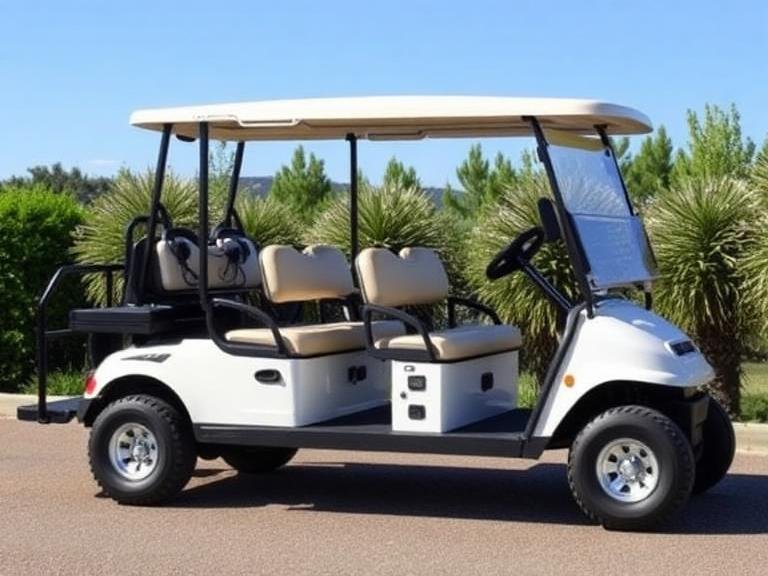
A true 6-passenger golf cart is not simply a standard cart with extra seats bolted onto the back. It is a purpose-built, stretched chassis engineered to support significantly more weight and passenger volume safely. The architecture typically consists of two forward-facing rows (accommodating four passengers) and one rear-facing flip seat (accommodating two passengers). The extended 6 person golf cart length is primarily concentrated in the vehicle’s wheelbase—the distance between the center of the front wheels and the center of the rear wheels.
This stretched wheelbase is structurally necessary to prevent the cart from tipping backward when fully loaded. If you are comparing a standard 4 Passenger Golf Cart to a 6-passenger model, the difference is generally an additional 30 to 40 inches added directly to the middle of the frame. This extended section must be supported by upgraded suspension components, heavy-duty leaf springs, and a more robust electric drivetrain to handle the payload.
How Length Impacts Performance and Turning
The physics of an extended cart directly dictate how it handles on the road. The longer the 6 person golf cart length, the wider its turning radius becomes. In most professional situations, operators must account for a turning clearance of 12 to 14 feet to execute a seamless U-turn. If you are navigating a standard 18-hole golf course with narrow, winding cart paths, a stretched 6-seater will require multi-point turns in areas where a standard cart effortlessly glides through.
Furthermore, length impacts ground clearance geometry. A long wheelbase is more susceptible to “high-centering” or bottoming out when cresting steep hills, speed bumps, or transitioning from a steep driveway to a flat street. This is why many buyers opt for a lifted 6 Passenger Golf Cart, which increases the ground clearance to compensate for the stretched midsection.
Quick Summary Table: Key Dimensions
| Dimension Category | Standard 2/4 Passenger Cart | Average 6 Passenger Cart | GT42R Thunder Series (6-Seater) |
|---|---|---|---|
| Overall Length | 92 – 108 inches | 144 – 156 inches | 144 inches |
| Wheelbase | 65 – 67 inches | 97 – 102 inches | 97 inches |
| Overall Width | 47 – 48 inches | 51 – 53 inches | 51 inches |
| Trailer Requirement | 5×10 foot trailer | 6×14 foot trailer | 6×14 foot trailer |
The Benefits of an Extended Chassis
Despite the larger footprint, the commercial and practical advantages of a 6-passenger cart are undeniable. First and foremost is efficiency. Moving six people in a single vehicle cuts your transportation time and energy consumption in half compared to deploying two separate carts. For families living in master-planned communities, it means the entire family—including grandparents and children—can travel to the neighborhood pool or clubhouse together.
Secondly, the longer wheelbase provides a noticeably superior ride quality. A stretched chassis absorbs road imperfections, bumps, and vibrations much more effectively than a short-wheelbase cart, resulting in a smoother, more stable experience for all passengers. When you evaluate the overall 6 Passenger Golf Cart Price, you are paying for this premium ride quality and massive utility upgrade.
The Limitations of a Longer Cart
The primary limitation is storage and transport infrastructure. Standard residential garages typically measure 20 to 24 feet deep. While a 12-foot cart will physically fit, it completely dominates the space, often preventing a standard mid-size SUV from parking alongside it. If your garage has built-in shelving, workbenches, or a water heater, the remaining depth may be insufficient.
Another severe limitation is trailering. You cannot load a 6-passenger cart onto a standard 10-foot landscaping trailer. The rear footrest will hang dangerously over the edge, creating a severe towing hazard and violating highway safety regulations. You must invest in a minimum 14-foot trailer to transport these vehicles safely.
Who Should Use It & Who Does Not Need It
For commercial users: Event venues, large resort properties, university campuses, and facility security teams should absolutely invest in 6-passenger carts. The ability to move VIP guests or large teams efficiently provides an immediate return on investment. If you are comparing Electric Golf Cart Models for a hotel shuttle service, a 6-seater is the undisputed minimum requirement.
Who does not need it: If your primary use case is solo golfing, or if you navigate a tight, heavily wooded property, a 6-seater is a liability. The expanded turning radius will frustrate you daily. Furthermore, for those looking for extreme portability, exploring a Foldable Golf Cart for Walking or a standard 2-seater is far more appropriate. Do not buy a 6-seater “just in case” you might have guests once a year; rent one for that weekend instead.
Comparison Table: 4 vs. 6 vs. 8 Passenger Carts
| Specification | 4 Passenger Cart | 6 Passenger Cart | 8 Passenger Cart |
|---|---|---|---|
| Average Length | 108 inches (9 ft) | 144 inches (12 ft) | 176 inches (14.6 ft) |
| Storage Footprint | Fits standard garage easily | Requires dedicated bay | Commercial storage required |
| Turning Radius | Excellent (Tight) | Moderate (Wide) | Poor (Bus-like) |
| Best Application | Couples, small families | Large families, resorts | Theme parks, airport shuttles |
Common Mistakes Buyers Make
In our testing and consulting with thousands of clients, we see the same logistical errors repeated constantly. The most common mistake is measuring the length from the front tire to the rear tire. The wheelbase is not the overall length. You must measure from the foremost point of the front bumper to the absolute rearmost edge of the rear footrest step. That rear footrest often extends 12 to 18 inches beyond the rear tires.
Another frequent error involves garage door clearance. While buyers obsess over the 6 person golf cart length, they forget the height. Lifted 6-passenger carts with extended roofs can measure up to 82 inches tall. A standard older residential garage door opening is often exactly 84 inches (7 feet). If your driveway has an upward slope into the garage, the roof of your cart will strike the garage door header.
Crucial Buying Considerations
Before purchasing, you must conduct a thorough physical audit of your operating environment. Measure your garage depth with the door closed. If you live in an HOA-governed community, check the bylaws; some neighborhoods strictly prohibit carts exceeding 120 inches in length on their private paths. Additionally, evaluate the Golf Cart Cost comprehensively. The longer frame requires a larger battery bank (often 72V lithium setups) to maintain adequate speed and torque, which increases the initial purchase price.
Pros and Cons of a 6-Passenger Golf Cart
| Pros | Cons |
|---|---|
| Maximizes passenger transport efficiency. | Requires a 14-foot minimum utility trailer for transport. |
| Extended wheelbase provides a remarkably smooth ride. | Wide turning radius complicates tight path navigation. |
| Excellent resale value in master-planned communities. | Takes up a massive footprint in residential garages. |
| Ideal for neighborhood trick-or-treating and events. | Higher battery strain reduces overall range per charge. |
Expert Recommendation & Featured Product
We recommend a 6-passenger cart strictly for buyers who consistently move 4 to 6 people multiple times per week. If this matches your lifestyle, the operational benefits far outweigh the storage inconveniences. When evaluating options, you should prioritize models that maximize seating while keeping the overall footprint as tight as structurally possible.
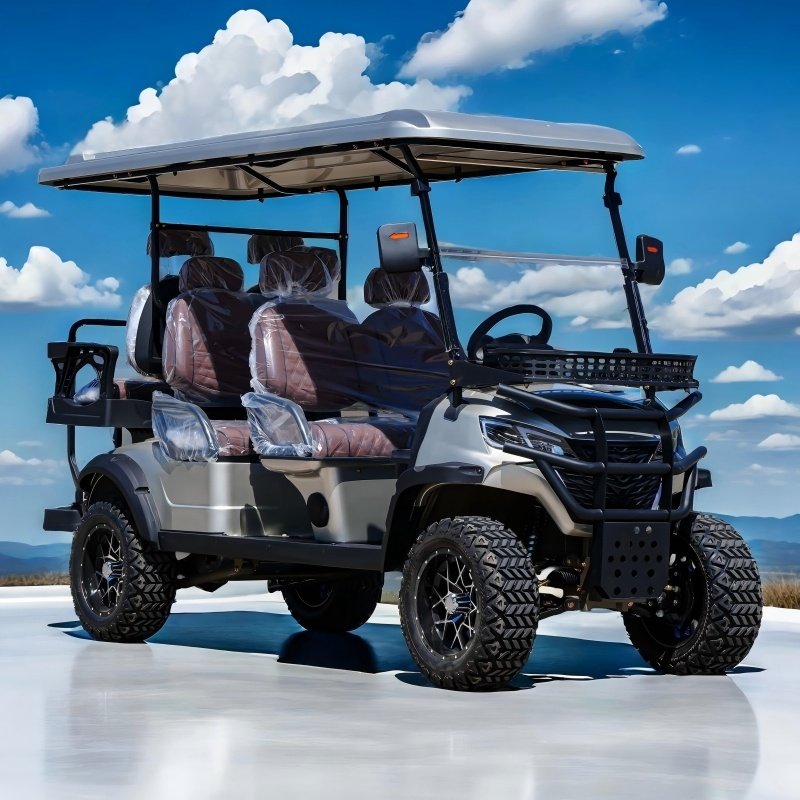
Golf Cart 6 Seater Low Speed Vehicle – Thunder Series GT42R
For heavy-duty applications and luxury neighborhood cruising, the GT42R Thunder Series is our uncompromising recommendation. We have engineered this vehicle to offer maximum cabin space without bloated exterior dimensions. It is officially classified to meet LSV standards, making it the perfect candidate if you are researching Street Legal Golf Cart Models.
- Overall Length: 144 inches (Exactly 12 feet, optimizing garage storage)
- Overall Width: 51 inches
- Overall Height: 80 inches
- Wheelbase: 97 inches
- Ground Clearance: 13 inches (Perfect for varied terrain)
- Dry Weight: 1195 lbs
This model perfectly threads the needle between massive passenger capacity and manageable vehicle length. It is absolutely worth buying if you demand premium build quality, elevated ground clearance, and a footprint that will actually fit inside your garage alongside your primary vehicle.
If you require even more capacity, such as a facility shuttle, you must step up to a 10 Passenger Electric Golf Cart, though be warned: you are entering commercial bus dimensions at that stage.
Frequently Asked Questions (FAQ)
Will a 6-passenger golf cart fit on a 10-foot trailer?
No. The average 6 person golf cart length is 12 feet (144 inches). Attempting to load it on a 10-foot trailer leaves the heavy rear seating section hanging off the back, which drastically alters the trailer’s tongue weight, causing dangerous swaying at highway speeds. You need a minimum 14-foot trailer.
Are 6-passenger golf carts allowed on standard golf courses?
In most professional situations, standard 18-hole golf courses prohibit 6-passenger carts. Their wide turning radius damages turf near tee boxes, and they are too long for standard cart staging areas. They are designed for street-legal community cruising, large estates, and commercial transport, not traditional golf play.
Does the longer length affect the battery lifespan?
Yes. A longer frame means a heavier dry weight (often over 1,100 lbs), plus the weight of up to six adults. This requires more continuous amperage draw from the battery pack to accelerate and climb hills. To maximize your Electric Golf Cart Lifespan, you must ensure your 6-seater is equipped with a high-capacity lithium battery system or a heavy-duty 72V lead-acid setup.
Authoritative References & Standards
To ensure your electric mobility decisions align with federal safety and transport guidelines, we recommend reviewing the standards set forth by these regulatory bodies:
- National Highway Traffic Safety Administration (NHTSA) – Provides exact federal definitions and dimension regulations for Low-Speed Vehicles (LSVs) intended for public roadways.
- American National Standards Institute (ANSI) – Publishes the ANSI/ILTA Z130.1 standard, which dictates safety and performance specifications for golf cars.
- Federal Motor Carrier Safety Administration (FMCSA) – Outlines the commercial and consumer cargo securement rules essential for safely trailering extended-length vehicles.