GT Golf Cart specializes in the design, manufacturing, and global supply of electric golf carts and low-speed vehicles. With over 12 years of industry experience, we deliver reliable mobility solutions for golf courses, resorts, communities, and commercial fleets worldwide. Navigating the modern mobility market requires a thorough understanding of vehicle specifications, regulatory compliance, and powertrain technologies. One of the most critical inquiries we receive from our global clientele revolves around financial planning: what is the true golf cart cost in 2026?

Over the past few years, the low-speed vehicle industry has undergone a technological renaissance. The widespread adoption of lithium-ion battery technology, integration of smart fleet management software, and rigorous street-legal compliance standards have all reshaped the baseline golf cart cost. Purchasing a vehicle today is an investment in micro-mobility infrastructure. In this authoritative guide, we will break down the variables that dictate the golf cart cost, compare different powertrains, evaluate custom upgrades, and provide a transparent pricing framework to guide your 2026 acquisition strategy.
Table of Contents
- 1. The 2026 Market Landscape: Understanding Golf Cart Cost
- 2. Powertrain Economics: Electric vs. Gas
- 3. Vehicle Categories and Pricing Tiers
- 4. Key Factors Influencing Your Golf Cart Cost
- 5. New vs. Used: Calculating Long-Term Value
- 6. Summary Table: 2026 Golf Cart Cost Breakdown
- 7. Frequently Asked Questions (FAQs)
- 8. Industry References
1. The 2026 Market Landscape: Understanding Golf Cart Cost
The micro-mobility sector has matured significantly. In 2026, the baseline golf cart cost reflects an industry shift away from disposable, single-use recreational vehicles toward durable, multi-purpose transportation solutions. Supply chain stabilization following the volatility of the early 2020s has allowed manufacturers to standardise pricing, but the integration of advanced safety features and high-capacity energy storage systems means the initial golf cart cost is higher than it was a decade ago.
From our experience, buyers must evaluate the golf cart cost through the lens of total cost of ownership (TCO). A lower upfront sticker price often obscures elevated maintenance requirements, frequent battery replacements, and lower resale value. When you browse premium golf carts for sale, you are evaluating vehicles engineered with aerospace-grade aluminum chassis, highly efficient AC AC-drive motors, and regenerative braking systems. These innovations justify the modern golf cart cost by drastically extending the operational lifespan of the vehicle.
2. Powertrain Economics: Electric vs. Gas
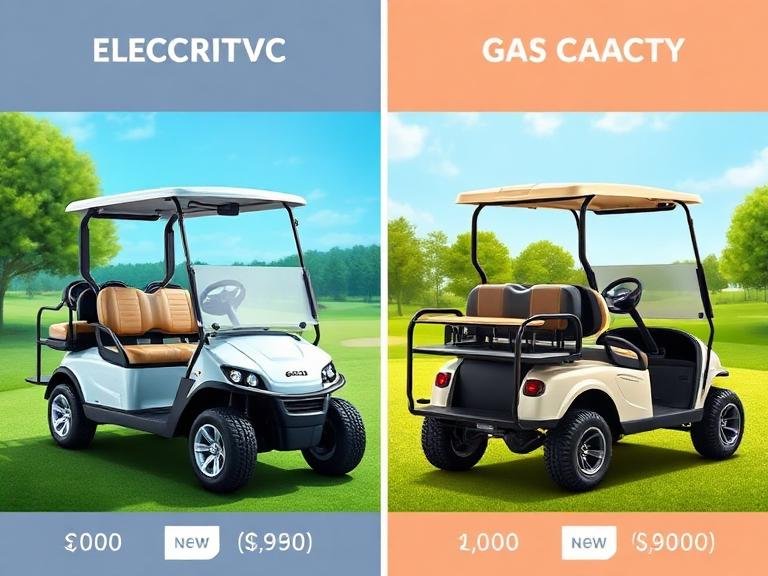
The primary determinant of your initial golf cart cost is the chosen powertrain. The industry remains divided between internal combustion engines and battery-electric platforms, though the market share has aggressively skewed toward electric propulsion in 2026.
An electric golf cart represents the pinnacle of operational efficiency. While the upfront golf cart cost for a lithium-ion electric model ranges between $8,500 and $14,000, the operational expenses are negligible. Electric models require no oil changes, spark plug replacements, or fuel filters. Furthermore, the cost to charge a lithium-ion battery pack is pennies on the dollar compared to current gasoline prices. We recommend electric powertrains for residential communities, golf courses, and eco-conscious resorts where silent, emission-free operation is mandatory.
Conversely, a gas golf cart is preferred in remote agricultural, hunting, or heavy-duty commercial applications where charging infrastructure is unavailable. The initial golf cart cost for a gas model is typically between $7,500 and $11,000. While the purchase price can occasionally be lower than a high-capacity lithium electric cart, buyers must factor in the ongoing costs of fuel, routine mechanical maintenance, and drive-belt replacements over the vehicle’s lifespan.
3. Vehicle Categories and Pricing Tiers
The intended application of the vehicle drastically alters the final golf cart cost. GT Golf Cart categorizes vehicles into distinct tiers based on their engineering specifications, safety equipment, and payload capacities.
Standard Fleet Models
Standard two-seat or four-seat models designed primarily for community cruising and golf course navigation represent the most accessible golf cart cost. These vehicles prioritize reliable transportation without excessive electronic integrations. In 2026, a standard, non-lifted model will feature a golf cart cost ranging from $7,000 to $9,500, depending on the battery configuration and seating capacity.
Street Legal and Road Legal Models
For residents in master-planned communities or coastal towns, mobility extends beyond private property. A street legal golf cart (also known as a Neighborhood Electric Vehicle or LSV) must adhere to strict Department of Transportation (DOT) regulations. These vehicles require specialized equipment, including AS1 DOT-approved windshields, backup cameras, three-point seatbelts, turn signals, horn systems, and a 17-digit Vehicle Identification Number (VIN).
Because of these mandatory safety integrations, the golf cart cost for a road legal golf cart is notably higher, typically falling between $10,500 and $15,000. From our experience, we recommend purchasing a factory-certified LSV rather than attempting to retrofit a standard cart, as retrofitting often leads to compliance issues and ultimately inflates the total golf cart cost through regulatory fines and failed inspections.
Luxury and Custom Builds
The demand for personalized micro-mobility has birthed an expansive premium market. When clients request custom golf carts, they are commissioning a vehicle tailored to their exact aesthetic and functional desires. Upgrades include custom metallic paint, lifted heavy-duty suspensions, 14-inch alloy wheels, and Bluetooth-enabled infotainment systems.
For those seeking the pinnacle of neighborhood transportation, luxury golf carts push the boundaries of design. These models feature premium marine-grade stitched seating, carbon fiber dash assemblies, and extended lithium-ion battery packs capable of 60+ miles of range. The golf cart cost for luxury and custom vehicles in 2026 starts around $14,000 and can easily exceed $22,000 depending on the level of bespoke fabrication required.
Utility and Commercial Fleets
Industrial applications require vehicles built for payload, towing, and continuous daily operation. A utility golf cart is engineered with reinforced steel cargo beds, heavy-duty transaxles, and rugged all-terrain tires. These models serve as the backbone for facility maintenance, landscaping, and warehouse logistics. The golf cart cost for a commercial utility vehicle ranges from $9,000 to $16,000, heavily influenced by the hydraulic dump bed options and specific payload requirements.
4. Key Factors Influencing Your Golf Cart Cost
Beyond the base model, several critical variables will dictate your final invoice. Understanding these factors will help you manage your golf cart cost effectively.
- Battery Chemistry: In 2026, Lithium Iron Phosphate (LiFePO4) batteries are the industry gold standard. While they increase the initial golf cart cost by $1,500 to $2,500 compared to traditional deep-cycle lead-acid batteries, they last up to five times longer, charge in a fraction of the time, and require zero water maintenance. We strongly recommend lithium configurations for optimal long-term ROI.
- Seating Capacity: A standard two-passenger cart will inherently feature a lower golf cart cost than a stretched six-passenger model. Adding rear-facing flip seats or extending the chassis requires heavier suspension components and larger motors to manage the increased weight.
- Shipping and Logistics: Global freight and domestic transport play a role in the final golf cart cost. Sourcing directly from an established manufacturer like GT Golf Cart often streamlines logistics, reducing the exorbitant destination charges commonly applied by third-party dealerships.
5. New vs. Used: Calculating Long-Term Value
Many buyers attempt to mitigate the golf cart cost by looking at the pre-owned market. While a used cart presents a lower initial acquisition price, it carries significant hidden liabilities. A used electric cart often requires an immediate battery replacement, which can instantly add $2,000 to $3,000 to your overall golf cart cost.
Furthermore, older models lack the advanced AC motor efficiency and smart controllers standard in 2026 models. From our experience, purchasing a new vehicle from a reputable manufacturer provides peace of mind through comprehensive multi-year warranties, guaranteed parts availability, and the latest safety engineering. We recommend viewing a new purchase as a predictable, fixed golf cart cost, protecting you from the volatile repair expenses associated with aging hardware.
6. Summary Table: 2026 Golf Cart Cost Breakdown
To assist in your financial planning, we have compiled a standardized matrix detailing the estimated golf cart cost across various vehicle categories for the 2026 model year.
| Vehicle Category | Average 2026 Price Range (USD) | Primary Use Case | Key Cost Drivers |
|---|---|---|---|
| Standard Electric / Gas | $7,000 – $9,500 | Golf course, private community | Battery type, basic accessories |
| Street Legal / LSV | $10,500 – $15,000 | Public roads (35 mph limit zones) | DOT safety glass, VIN, lighting kits |
| Custom & Luxury | $14,000 – $22,000+ | Premium neighborhood cruising | Lift kits, custom paint, infotainment |
| Commercial Utility | $9,000 – $16,000 | Maintenance, farming, industrial | Cargo beds, heavy-duty suspension |
7. Frequently Asked Questions (FAQs)
Why is the golf cart cost for lithium models higher than lead-acid?
Lithium-ion battery packs utilize advanced cell chemistry and integrated Battery Management Systems (BMS) to protect against overcharging and thermal events. While this technology increases the initial golf cart cost, lithium batteries eliminate routine maintenance, reduce the overall vehicle weight, and offer a lifespan of 8-10 years, drastically lowering your total cost of ownership.
Does adding a lift kit significantly impact the golf cart cost?
Yes. Installing a lift kit is not just about raising the chassis; it requires specialized suspension arms, heavy-duty shock absorbers, and larger all-terrain wheels and tires. A quality lift kit installation will generally add $800 to $1,500 to your total golf cart cost.
Are there financing options available to offset the upfront golf cart cost?
Absolutely. Most reputable manufacturers and distributors offer consumer and commercial financing programs. By spreading the golf cart cost over 36 to 60 months, buyers can acquire premium street-legal or lithium-powered models with manageable monthly payments rather than a large lump-sum capital expenditure.
8. Industry References
To ensure regulatory compliance and safety when evaluating your vehicle investment, we recommend consulting the following authoritative bodies regarding low-speed vehicle (LSV) standards and environmental guidelines:
“`