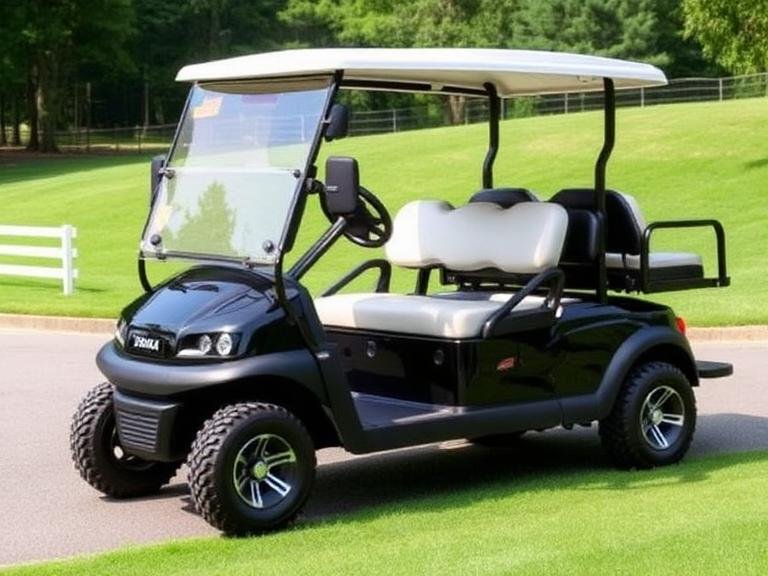
Managing the logistical movement of guests across a sprawling resort, an expansive corporate campus, or a crowded airport requires absolute precision. In the commercial transportation sector, relying on an undersized fleet leads to unacceptable guest wait times, while deploying oversized, unmaneuverable vehicles results in property damage and operational bottlenecks. For fleet managers and procurement directors, the decision inevitably comes down to analyzing the 8 Passenger Golf Cart vs 10 Passenger Golf Cart dilemma.
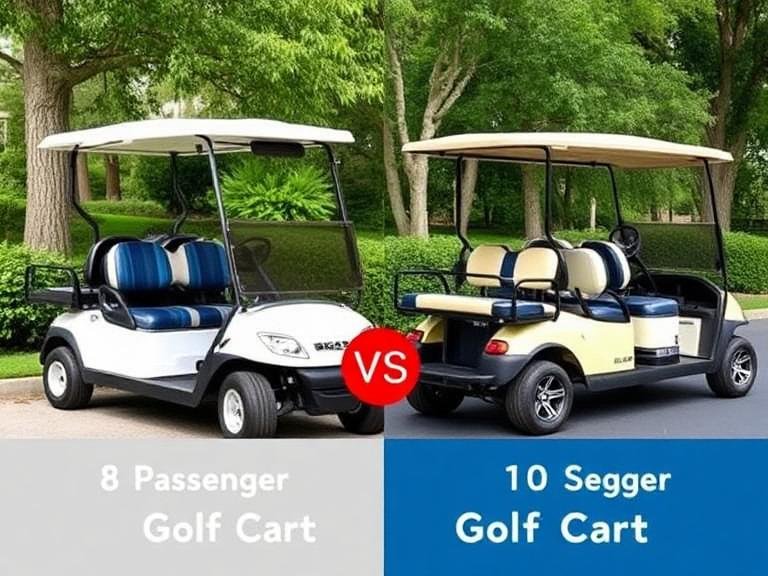
From our experience engineering and deploying thousands of high-capacity Commercial Golf Cart models globally, we consistently see buyers make costly procurement errors by assuming that “bigger is always better.” An extra row of seating alters the vehicle’s wheelbase, turning radius, and battery draw significantly. In this comprehensive guide, we will break down the commercial and practical realities of both chassis types, helping you make a decisive, ROI-positive buying decision for your facility.
Quick Answer: The Bottom Line for Fleet Managers
When evaluating the 8 Passenger Golf Cart vs 10 Passenger Golf Cart, your decision must be dictated by your property’s physical layout and your peak-hour throughput requirements.
- Choose the 8 Passenger Cart if: Your facility features tight corners, narrow pathways, or standard-sized parking infrastructure. It offers the best balance of high capacity and maneuverability.
- Choose the 10 Passenger Cart if: You operate a massive, open-layout facility (like a theme park, airport, or stadium parking lot) where moving the absolute maximum number of people per driver wage-hour is the primary metric of success.
In most professional situations, we recommend pairing heavy-duty multi-passenger carts with 72V Lithium-ion systems. Heavy payloads will rapidly degrade standard 48V lead-acid batteries.
Table of Contents
- What Are High-Capacity Golf Carts?
- How Commercial People Movers Work
- Head-to-Head Comparison Table
- The Commercial Benefits of Upgrading
- Limitations and Logistical Realities
- Pros and Cons Table
- Who Should Use the 8-Passenger Model
- Who Should Use the 10-Passenger Model
- Common Fleet Procurement Mistakes
- Expert Buying Considerations
- GT Golf Cart Expert Recommendation
- Frequently Asked Questions (FAQ)
What Are High-Capacity Golf Carts?
A standard golf cart is designed for two golfers and their bags. High-capacity models, specifically the 8 Passenger Golf Cart and the 10 Passenger Golf Cart, are heavily modified “stretched” chassis vehicles built strictly for commercial people-moving. They feature three or four forward-facing rows, respectively, and typically one rear-facing fold-down seat row.
These are not merely longer versions of standard carts. To handle payloads exceeding 1,500 pounds, these vehicles require reinforced tubular steel or aircraft-grade aluminum frames, heavy-duty leaf spring suspensions, and upgraded braking systems. They are the backbone of hospitality transport, bridging the gap between a standard 6 Passenger Golf Cart and a full-sized commercial bus.
How Commercial People Movers Work
Moving ten adults simultaneously puts an immense strain on a vehicle’s drivetrain. In modern Electric Golf Cart manufacturing, high-capacity people movers discard the outdated DC motors of the past. Instead, they utilize advanced AC (Alternating Current) induction motors. AC motors provide significantly higher torque, which is essential for pulling a fully loaded 10-passenger cart up an incline without stalling.
Power delivery is managed by high-amp controllers (typically 400A to 600A) drawing from massive battery banks. While older models relied on banks of heavy lead-acid batteries, the industry standard has shifted to Lithium-ion (LiFePO4) technology. Lithium maintains a constant voltage output regardless of the payload weight, ensuring the vehicle does not slow down to a crawl when fully loaded during the final hours of a driver’s shift.
8 Passenger Golf Cart vs 10 Passenger Golf Cart: Head-to-Head Comparison
To accurately evaluate the 8 Passenger Golf Cart vs 10 Passenger Golf Cart, you must look at the specific engineering metrics that dictate operational efficiency.
| Metric / Specification | 8 Passenger Golf Cart | 10 Passenger Golf Cart |
|---|---|---|
| Seating Configuration | 3 Rows Forward-Facing, 1 Row Rear-Facing | 4 Rows Forward-Facing, 1 Row Rear-Facing |
| Average Turning Radius | Approx. 16 – 18 feet | Approx. 20 – 24 feet |
| Typical Payload Capacity | 1,200 – 1,500 lbs | 1,800 – 2,200 lbs |
| Minimum Recommended Voltage | 48V to 72V Lithium-ion | 72V Lithium-ion (Strictly Required) |
| Braking Requirement | Rear Mechanical Drums (Acceptable) | 4-Wheel Hydraulic Disc (Mandatory) |
| Ideal Environment | Resorts, campuses, mid-sized paths | Airports, stadiums, wide-open straightaways |
The Commercial Benefits of Upgrading to High-Capacity Carts
The primary benefit of utilizing either an 8 or 10-passenger cart is labor efficiency. Driver wages are the highest ongoing operational cost for any transport fleet. If you need to move 40 guests from a parking lot to a stadium gate, using standard 4-passenger carts requires 10 drivers. Using 10-passenger carts requires only 4 drivers. The return on investment (ROI) achieved by slashing payroll expenses justifies the higher initial capital expenditure of the larger vehicles almost immediately.
Furthermore, consolidating your fleet into fewer, larger vehicles reduces maintenance overhead. You have fewer tires to replace, fewer motors to service, and fewer insurance policies to maintain compared to running a massive fleet of smaller carts.
Limitations and Logistical Realities
We must apply commercial judgment here: you cannot put a 10-passenger cart everywhere. The primary limitation of the 10-passenger model is its massive wheelbase. Attempting to navigate a 10-passenger cart through a historic resort with 90-degree winding paths will result in the vehicle becoming stuck or the driver tearing up the landscaping trying to swing wide. The extended chassis is also prone to “bottoming out” if driven over sharp crests, speed bumps, or uneven terrain.
Pros and Cons Table
| Vehicle Type | Pros (Advantages) | Cons (Limitations) |
|---|---|---|
| 8 Passenger Cart | Excellent balance of capacity and agility. Can navigate standard resort pathways. Less battery drain per shift than a 10-passenger. | Leaves 2 potential seats on the table compared to max capacity models. Still requires a wide berth for tight U-turns. |
| 10 Passenger Cart | Maximum possible throughput per driver wage-hour. Ultimate VIP shuttle for large, unified groups. Reduces overall fleet size requirements. | Terrible turning radius; requires wide roads. Requires heavy-duty 72V lithium and 4-wheel disc brakes. Higher initial purchase price. |
Who Should Use an 8-Passenger Cart (And Who Does Not Need It)
Who Should Use It: We recommend the 8-passenger configuration for luxury hotels, academic campuses, wedding venues, and corporate facilities. If you operate a property where a Luxury Golf Cart aesthetic is required and you need to move moderate-sized groups through moderately sized pathways, the 8-passenger is the sweet spot of the industry.
Who Does Not Need It: If you run a standard 18-hole golf course, stretching to an 8-passenger vehicle is entirely unnecessary and will severely damage your fairways. Stick to standard 2-passenger or 4-passenger fleets.
Who Should Use a 10-Passenger Cart (And Who Does Not Need It)
Who Should Use It: For heavy-duty applications, the 10-passenger cart reigns supreme. We strongly advise mega-churches, massive theme parks, airport tarmac transport, and stadium parking lot management teams to deploy these vehicles. When the roads are wide and the volume is relentless, this is your premier workhorse.
Who Does Not Need It: Do not purchase a 10-passenger cart if your facility has narrow gates, sharp switchbacks, or if you lack dedicated, oversized parking spaces. You will spend more money repairing fiberglass body damage from corner-clipping than you will save on labor.
Common Fleet Procurement Mistakes
Expert Insight: The most catastrophic mistake we see fleet managers make is purchasing a 10-passenger cart equipped with standard 48V lead-acid batteries and rear-only mechanical drum brakes.
When you put 10 adults on a cart, you are adding over 1,800 pounds of payload. A 48V lead-acid system will suffer severe voltage sag under that load, causing the cart to crawl at 5 mph up slight inclines. Worse, mechanical drum brakes on the rear axle only are dangerously insufficient for stopping that much mass. You will experience massive brake fade, creating a severe liability issue.
Expert Buying Considerations
When deciding the outcome of the 8 Passenger Golf Cart vs 10 Passenger Golf Cart debate for your facility, mandate the following specifications in your procurement contract:
- Powertrain: Insist on a 72V Lithium-ion battery system paired with an AC motor of at least 5,000 Watts.
- Braking System: Four-wheel hydraulic disc brakes are non-negotiable for 10-passenger models and highly recommended for 8-passenger models.
- Street Legality: If your route requires crossing public roads to reach overflow parking, ensure the manufacturer provides a Low-Speed Vehicle (LSV) compliant Street Legal Golf Cart package, complete with a 17-digit VIN, DOT windshield, and 3-point seatbelts.
GT Golf Cart Expert Recommendation
In our professional manufacturing experience, resolving the high-capacity transport challenge requires uncompromising engineering. You cannot simply bolt more seats onto a standard chassis and hope for the best. At GT Golf Cart, we design our multi-passenger vehicles from the ground up to handle extreme commercial stress.
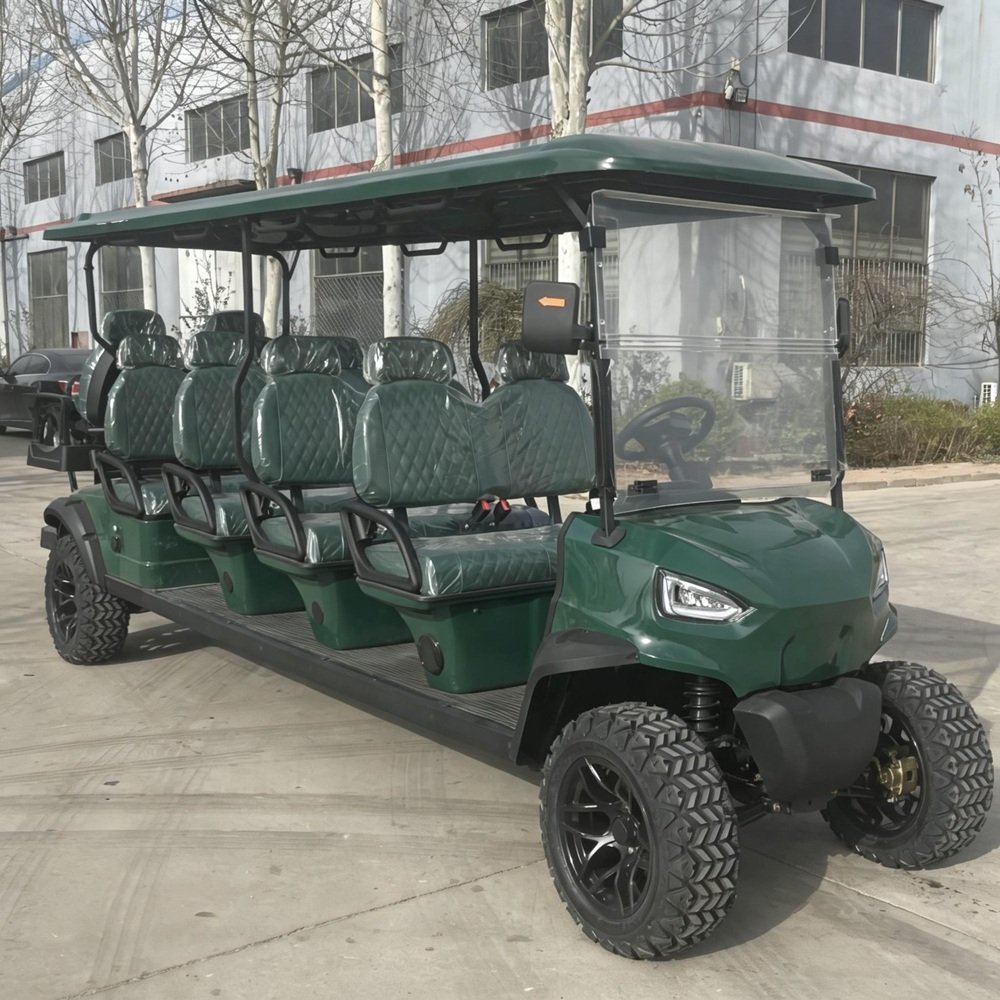
10 Passenger Electric Golf Cart GT82R-1
For commercial facilities demanding maximum throughput without sacrificing reliability or aesthetic appeal, the GT82R-1 is the definitive solution. Engineered specifically as a heavy-duty people mover, it features a massive 72V lithium power plant and an AC induction motor capable of hauling full payloads without performance degradation.
| Engine Type | AC Electric Motor |
| Rated Power | 5,000 W |
| Battery System | Lithium 72V 150Ah |
| Max. Driving Range | 62 miles per charge |
| Top Speed | 29 mph |
| Charging Time | 7–9 hours (110V/120V Standard Port) |
View the GT82R-1 Fleet Solution
Whether you need the slightly more agile 8-passenger model or the ultimate high-volume GT82R-1 10-passenger unit, bypassing the middleman to buy directly from a specialized manufacturer like us ensures you receive fleet-grade durability. For unique branding requirements, we also offer Custom Golf Cart configurations to match your resort or corporate identity perfectly.
Frequently Asked Questions (FAQ)
Are 10-passenger golf carts street legal?
They can be, provided they are manufactured to meet federal Low-Speed Vehicle (LSV) standards. This requires specific safety equipment including DOT-approved seatbelts, windshields, backup cameras, turn signals, and a top speed electronically limited to 25 MPH. You must also register the vehicle with your local DMV.
How much weight can an 8-passenger golf cart hold?
A properly engineered commercial 8-passenger golf cart typically features a payload capacity between 1,200 and 1,500 pounds. This is calculated to safely accommodate eight average-sized adults along with light baggage without overwhelming the suspension or braking systems.
Why do high-capacity carts require Lithium batteries?
Heavy payloads cause massive voltage sag in traditional lead-acid batteries, leading to slow speeds and overheating. Lithium-ion batteries provide sustained, flat-line voltage delivery, ensuring the cart has full power even when hauling 10 passengers uphill. They also reduce the vehicle’s overall weight by up to 300 pounds.
Can an 8-passenger cart fit in a standard parking space?
Yes, in most professional situations, an 8-passenger golf cart is roughly 140 to 150 inches long, which fits comfortably within a standard 18-foot automobile parking space. A 10-passenger cart, however, can exceed 165 inches and often requires modified parking arrangements.
Authoritative References & Industry Safety Standards
To ensure our fleet recommendations meet strict operational compliance, we adhere to guidelines set forth by the following authoritative bodies:
- National Highway Traffic Safety Administration (NHTSA): Federal safety standards and classifications for Low-Speed Vehicles (LSVs) intended for public road integration. Visit NHTSA
- American National Standards Institute (ANSI): Safety and performance specifications specifically detailing braking and stability requirements for multi-passenger golf cars (ANSI/OPEI Z130.1 standard). Visit ANSI
- Occupational Safety and Health Administration (OSHA): Federal guidelines protecting employees operating heavy-duty motorized utility vehicles in commercial and industrial environments. Visit OSHA