The global transition toward sustainable micro-mobility has fundamentally transformed how communities, resorts, and industrial facilities manage localized transportation. As consumers and fleet managers pivot away from traditional internal combustion engines, the demand for versatile, low-speed electric vehicles has surged. At GT Golf Cart, we operate as a professional manufacturer specializing in electric golf carts, sightseeing vehicles, and low-speed electric vehicles. Since our establishment, we have focused on delivering durable, efficient, and customizable electric mobility solutions for global markets. Backed by 12+ years of experience, outputting 10+ containers monthly, and having served 40+ countries, we encounter one recurring question from procurement officers and private buyers alike: what is the fundamental difference between 4 person and 6 person golf carts?
From our experience engineering and exporting diverse fleet lineups, selecting the correct chassis capacity is the single most critical decision in the procurement process. It is a common misconception that adding seating capacity is merely a matter of bolting on additional cushions. In reality, the difference between 4 person and 6 person golf carts encompasses profound structural alterations, powertrain upgrades, suspension recalibrations, and turning radius expansions. Whether you are outfitting a sprawling luxury resort, managing a gated community, or navigating a massive industrial complex, understanding these mechanical and practical distinctions will dictate your total cost of ownership and operational efficiency. In this comprehensive, expert-led analysis, we will dissect the engineering variances, primary use cases, and long-term economic impacts to guide you toward the optimal Electric Golf Cart configuration.
Table of Contents
- 1. Structural Engineering and Chassis Dimensions
- 2. Powertrain Dynamics and Battery Specifications
- 3. Suspension Capabilities and Payload Handling
- 4. Spatial Footprint and Maneuverability Limits
- 5. Evaluating Primary Use Cases
- 6. Beyond Standard Capacities: Fleet Integration
- 7. Summary Table: Difference Between 4 Person and 6 Person Golf Carts
- 8. Frequently Asked Questions (FAQs)
- 9. Industry References
1. Structural Engineering and Chassis Dimensions
To fully grasp the difference between 4 person and 6 person golf carts, one must look at the foundational skeleton of the vehicle: the chassis. The structural integrity of a low-speed electric vehicle determines its safety, rigidity, and lifespan under continuous load.
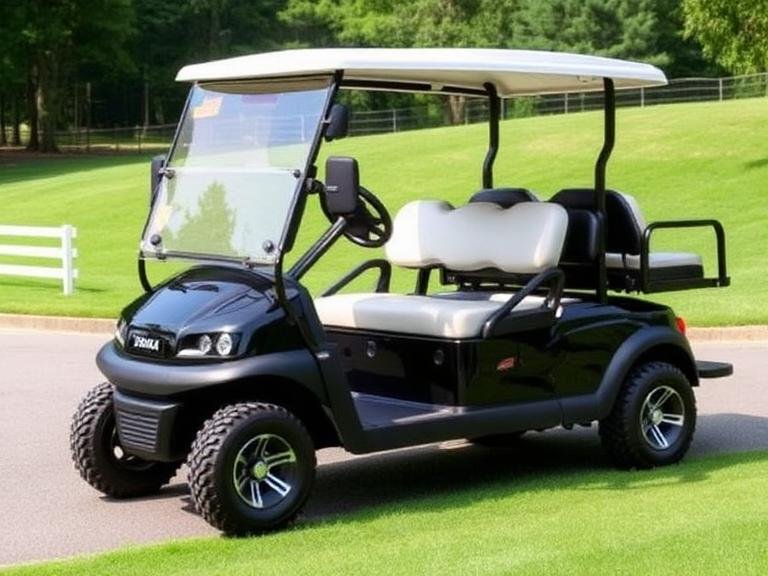
A standard 4 Passenger Golf Cart is typically engineered on a short-wheelbase platform. In most manufacturing environments, this is the exact same chassis utilized for a 2 Passenger Golf Cart, but outfitted with a rear-facing flip seat kit bolted to the rear struts and bag well. This 2+2 configuration maintains a highly compact footprint. Because the wheelbase remains short, the structural stress is centralized, allowing for standard-gauge steel or aluminum framing.
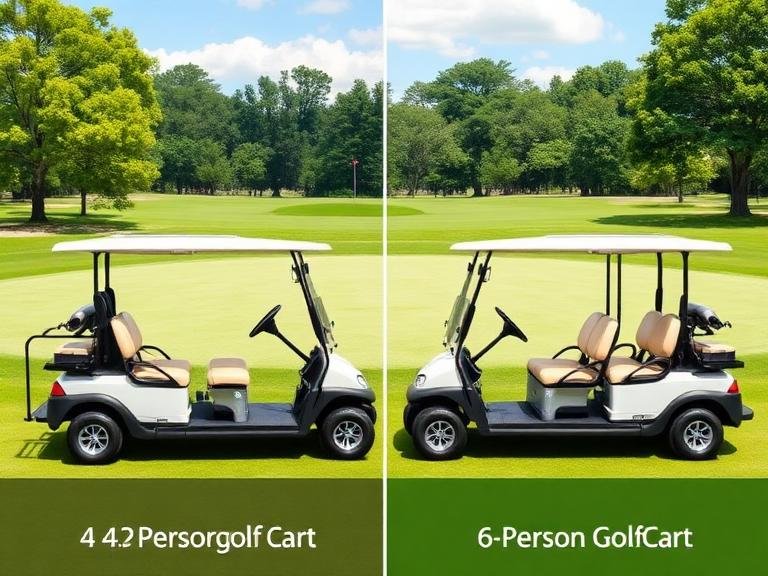
Conversely, a 6 Passenger Golf Cart cannot be safely built on a standard short wheelbase. To accommodate an additional forward-facing row of seats (resulting in a 4+2 or 2+2+2 configuration), the chassis must be physically stretched by approximately 30 to 40 inches during the manufacturing process. From our experience, this elongated frame requires heavy-duty cross members and thicker tubular steel to prevent the chassis from bowing or flexing under the weight of six adult passengers. This extended wheelbase is the most defining visual and structural difference between 4 person and 6 person golf carts, fundamentally altering the vehicle’s center of gravity.
2. Powertrain Dynamics and Battery Specifications
Adding two additional adult passengers introduces an extra 350 to 500 pounds of payload. When you increase payload, the electrical and mechanical systems must scale proportionately to prevent rapid component failure. We recommend that buyers closely audit the powertrain specifications when comparing these two vehicle classes.
In a standard 4 Passenger Golf Cart, a 48-volt electrical system paired with a 4.0 kW AC or DC motor is generally sufficient to conquer moderate inclines and maintain a top speed of 15 to 20 miles per hour. The controller, which regulates amperage from the battery to the motor, typically operates efficiently at 250 to 300 amps.
However, the difference between 4 person and 6 person golf carts becomes glaringly apparent on steep gradients. An underpowered 6-seater will rapidly overheat its motor and trip its thermal protection circuits if attempting to carry maximum capacity up a hill. Therefore, professional manufacturers equip the 6 Passenger Golf Cart with robust 5.0 kW to 7.5 kW AC motors, paired with upgraded 400-amp to 600-amp controllers. Furthermore, to maintain a viable driving range, the battery bank must be expanded. While a 4-passenger unit might utilize standard 8-volt lead-acid configurations or a 105Ah lithium pack, a 6-passenger model often requires high-capacity 160Ah lithium systems to deliver consistent torque and range without premature voltage sag.
3. Suspension Capabilities and Payload Handling
The ride quality of an Electric Golf Cart is directly correlated to its suspension architecture. From our experience supplying custom transport solutions to luxury resorts, passenger comfort cannot be compromised. The difference between 4 person and 6 person golf carts requires drastically different suspension tuning.
A 4-person cart typically utilizes standard leaf springs in the rear with a basic independent front suspension. The load variance between two passengers and four passengers is manageable within the tolerances of standard shock absorbers. However, a 6-person cart must support a gross vehicle weight that frequently exceeds 2,000 pounds when fully loaded. To prevent bottoming out and to counteract body roll on corners, 6-passenger chassis are equipped with heavy-duty, multi-leaf rear springs, upgraded panhard rods, and stiffened front struts. Buyers must note that when a heavy-duty 6-seater is driven with only one or two passengers, the stiffened suspension may result in a noticeably firmer, less forgiving ride compared to a similarly lightly-loaded 4-seater.
4. Spatial Footprint and Maneuverability Limits
One of the most frequent oversights made by procurement officers is failing to account for the spatial realities of their operational environment. The turning radius is a crucial difference between 4 person and 6 person golf carts.
Due to its short wheelbase, a 4 Passenger Golf Cart offers exceptional maneuverability. It can navigate tight golf course paths, weave through congested marina docks, and easily perform U-turns on narrow residential streets. Furthermore, its overall length (typically around 105 to 110 inches) allows it to be parked inside standard single-car garages alongside a primary vehicle or transported on a standard 5×10 utility trailer.
The 6 Passenger Golf Cart, featuring an overall length stretching between 140 and 155 inches, operates with a significantly wider turning circle. It cannot maneuver through tight switchbacks without executing three-point turns. Garage storage requires dedicated, deep bays, and transportation demands a minimum 14-foot tandem axle trailer. If your operational zone includes narrow paved paths, sharp blind corners, or limited parking infrastructure, we strongly recommend evaluating the turning constraints before committing to the larger chassis.
5. Evaluating Primary Use Cases
Understanding the mechanical difference between 4 person and 6 person golf carts is only half the equation; applying that knowledge to your specific transportation needs is where true procurement value is generated.
5.1 When to Deploy the 4 Passenger Golf Cart
The 4-seater is the undisputed king of residential communities and private estates. It is the perfect balance of utility and compact efficiency. We recommend this configuration for families running neighborhood errands, security patrols in gated communities, and golfers who desire the ability to occasionally carry passengers on the rear flip seat. It is also the preferred chassis for a Custom Golf Cart build where aggressive lift kits and oversized mud tires are desired, as the shorter wheelbase is far more capable in off-road, uneven terrain scenarios than an extended chassis.
5.2 When to Upgrade to the 6 Passenger Golf Cart
The 6-seater transitions from a personal vehicle to an institutional people-mover. We recommend this platform for massive operational campuses, luxury hotel guest transportation, airport terminal shuttling, and large families living in master-planned communities. As a Commercial Golf Cart, the 6-seater excels in moving VIPs or tour groups efficiently, drastically reducing the number of vehicles required in a commercial fleet, thereby lowering insurance and fleet management software costs.
6. Beyond Standard Capacities: Fleet Integration
While this guide focuses on the specific difference between 4 person and 6 person golf carts, GT Golf Cart’s manufacturing capabilities extend far beyond these parameters. For highly specialized industrial or commercial applications, standard capacities may still fall short. In environments such as theme parks, massive manufacturing plants, or large-scale university campuses, we engineer the 8 Passenger Golf Cart and the ultra-capacity 10 Passenger Golf Cart. These elongated sightseeing vehicles function essentially as trackless trams, requiring customized hydraulic braking systems and massive AC drive trains. Conversely, for facility maintenance and cargo transport where passenger capacity is secondary, a dedicated 2 Passenger Golf Cart outfitted with an aluminum utility bed provides unmatched industrial utility.
7. Summary Table: Difference Between 4 Person and 6 Person Golf Carts
To assist in your strategic purchasing decision, we have compiled a definitive comparison matrix outlining the operational and mechanical distinctions between the two primary chassis sizes.
| Specification / Feature | 4 Passenger Golf Cart | 6 Passenger Golf Cart |
|---|---|---|
| Chassis Architecture | Standard short wheelbase | Extended long wheelbase (stretched 30-40″) |
| Seating Configuration | 2 forward-facing, 2 rear-facing (flip seat) | 4 forward-facing, 2 rear-facing |
| Motor Requirement | Standard 4.0 kW (AC or DC) | Heavy-Duty 5.0 kW – 7.5 kW (AC preferred) |
| Turning Radius | Tight; excellent for narrow trails | Wide; requires ample space for U-turns |
| Suspension Setup | Standard leaf springs / coils | Heavy-duty multi-leaf springs required |
| Garage Storage | Fits standard single-car dimensions | Requires deep bay or dedicated storage |
| Primary Application | Residential, standard golf, security | Resorts, large families, commercial shuttling |
8. Frequently Asked Questions (FAQs)
Does the difference between 4 person and 6 person golf carts affect top speed?
Generally, the top speed is dictated by local Low-Speed Vehicle (LSV) regulations, which cap speeds at 25 mph regardless of the vehicle size. However, from our experience, a fully loaded 6-seater requires a significantly larger AC motor and controller to maintain that top speed on inclines. Without upgraded powertrain components, a 6-seater will experience severe speed degradation when carrying six adults up a hill compared to a 4-seater.
Can I convert a 4-passenger cart into a 6-passenger cart?
No, not safely or legally. The structural difference between 4 person and 6 person golf carts requires the chassis to be physically cut, extended, and re-welded. Attempting to bolt a massive extension onto a short-wheelbase frame compromises the vehicle’s structural integrity, voids the manufacturer’s warranty, and creates severe tipping hazards. If you need a 6-seater, you must purchase a factory-built extended chassis.
Why does GT Golf Cart recommend lithium batteries for 6 passenger vehicles?
Lead-acid batteries are incredibly heavy, often adding 300 to 400 pounds to the vehicle. A 6-passenger cart is already heavy due to the extended steel frame. Adding six adults plus the weight of lead-acid batteries puts immense strain on the suspension and motor. Lithium batteries weigh a fraction of lead-acid equivalents, deliver consistent high-amperage output for steep hills, and require zero maintenance, making them the superior choice for high-capacity vehicles.
Are 6-passenger carts street legal?
Street legality depends entirely on your local municipal codes and whether the vehicle is homologated as an LSV (Low-Speed Vehicle). An LSV requires a 17-digit VIN, DOT-approved windshields, seatbelts, turn signals, and hydraulic brakes. Both 4-passenger and 6-passenger models can be manufactured to LSV standards. We recommend checking with your local Department of Motor Vehicles prior to operation on public roads.
9. Industry References
To further understand the mechanical standards, battery chemistries, and safety regulations governing the global low-speed electric vehicle market, we recommend consulting the following authoritative organizations:
- National Highway Traffic Safety Administration (NHTSA) – Low-Speed Vehicle Federal Motor Vehicle Safety Standards (FMVSS 500)
- SAE International – Global Engineering Standards for Electric Vehicle Powertrains and Battery Safety
- American National Standards Institute (ANSI) – Standards for Golf Car Safety and Performance Specifications (Z130.1)